
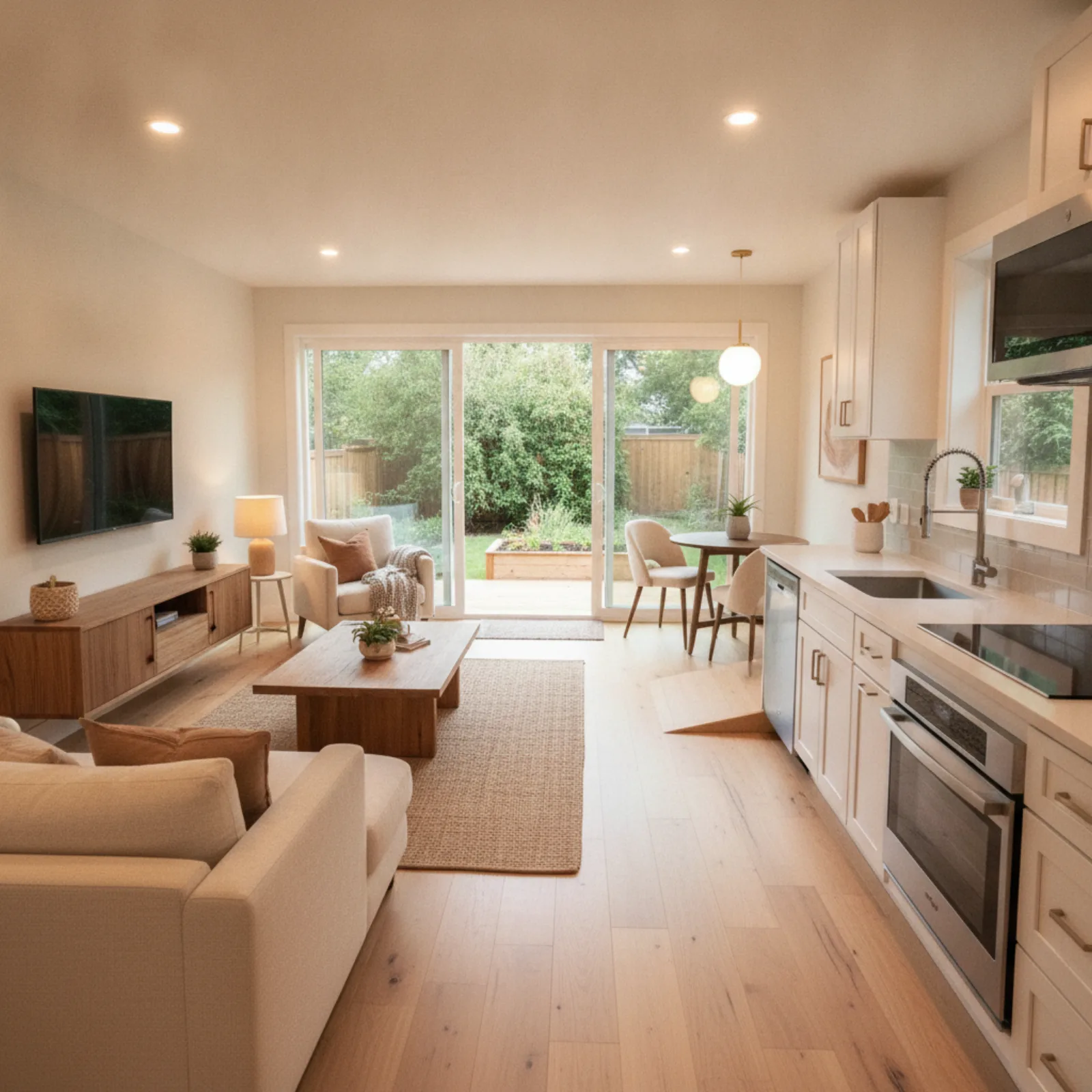
For a lot of San Diego families, the conversation starts with a phone call. Maybe your mom had a fall. Maybe your dad mentioned he’s been lonely. Maybe you’ve watched the assisted living costs and realized you cannot afford to hand your parents over to a system that doesn’t know them. Building an ADU for aging parents isn’t a real estate decision first. It’s a family decision. The real estate part just makes it possible.
We work with multigenerational families all over San Diego County. Here’s what we’ve learned about getting it right.
Keeping Family Close Without Losing Independence
The word that comes up in almost every conversation we have is “independence.” Parents don’t want to feel like a burden. Adult kids don’t want their parents to feel managed. And genuinely, most people want their own space, their own kitchen, their own front door.
A well-designed ADU gives everyone exactly that. Your parents are 30 feet away, not 30 minutes. You can check in without announcing yourself three days in advance. Grandkids can run back and forth freely. But when the day is done, everyone goes home to their own place.
That separation is not distance. It’s dignity.
“We built a casita for my mom in our backyard. She has her own kitchen, her own bathroom, her own door. She’s not living with us. She’s living next to us. It’s different.”, ADUz client, Escondido
Designing for Accessibility from the Start
If you’re building an ADU for an aging parent, design for where they’re going, not just where they are right now. The cost difference between a standard ADU and one built for long-term accessibility is smaller than most people expect. The regret of not doing it is larger.
Single-Level is the Foundation
No stairs. Full stop. Every ADU we design for multigenerational families is single-level. This is the single most important accessibility decision you’ll make, and it costs nothing extra in a new build.
Wider Doorways and Hallways
Standard doorways are 28-30 inches. Accessible doorways are 32-36 inches. If your parent ever uses a walker or wheelchair, standard doors become obstacles. We build accessible widths by default into every ADU we design for aging-in-place.
Walk-In Shower With No Threshold
A step-in shower is a fall risk as mobility changes. A curbless or low-threshold walk-in shower with a fold-down bench and grab bars costs only marginally more and makes the bathroom genuinely safe for decades.
Grab Bars and Blocking
Even if your parent doesn’t need grab bars today, we can rough in blocking inside the walls during construction so bars can be added later without major work. This is a small cost now and a significant convenience later.
Designing for accessibility at the start costs a fraction of retrofitting later. If you’re building an ADU for a parent in their 70s, design as if they’re in their 80s. You’ll be glad you did.
Privacy for Everyone
One thing families underestimate is how much thought goes into the site plan, and how much that planning affects the relationship long-term.
We look at:
Entry orientation. Your parent’s front door should feel like their front door, not a side gate off your backyard. Where their door faces, and what they see when they step outside, shapes how they feel about the space.
Window placement. You don’t want your parent’s bedroom window looking directly into your kitchen window. We think through sightlines so both homes feel like private residences, not a main house and a guest room.
Shared vs. separate utilities. Separate meters give parents full control over their own bills and usage. It also simplifies things significantly if the unit is ever rented in the future.
Parking. If your parent drives, or if their caregiver drives, where does that car go? We factor this into the site plan early.
The Peace of Mind Is the Point
We’ve built ADUs for families where the parent was fully independent. We’ve built them for families where the parent needed daily check-ins. We’ve built them for grandparents who wanted to be near grandchildren while their adult kids worked. Every situation is different.
What’s consistent is this: the family that builds the ADU almost always tells us they wish they’d done it sooner. Not because of money, but because of time. The years when a grandparent is close enough to show up for dinner, to watch a game, to be part of the rhythm of a household rather than a quarterly visit.
An ADU is one of the most practical things a family can build. It’s also one of the most human.
What It Costs and How to Plan
For a well-designed 400-600 sq ft ADU in San Diego County, all-in costs typically range from $140,000 to $200,000 depending on site conditions, finishes, and city. That includes design, permits, and construction.
If you’re using the unit for a family member now, you may eventually rent it when circumstances change. That optionality is built in. The unit is yours. It adapts as your family does.
California has also eliminated many of the fees and barriers that used to make ADUs expensive to permit. In most San Diego County cities, ADUs under 750 sq ft pay no impact fees. We handle the permitting process start to finish, so you’re not navigating city code on your own.
If you’re thinking about building an ADU for a parent or family member, the first step is a conversation. Call ADUz at (760) 524-1754 for a free consultation. We’re a family-owned, bilingual team. ADUz designs and permits; our licensed build partner, The Rock Remodel (CA Lic. 1042918), builds it. We’ve helped a lot of San Diego families through this decision, and we’d be glad to help yours.