
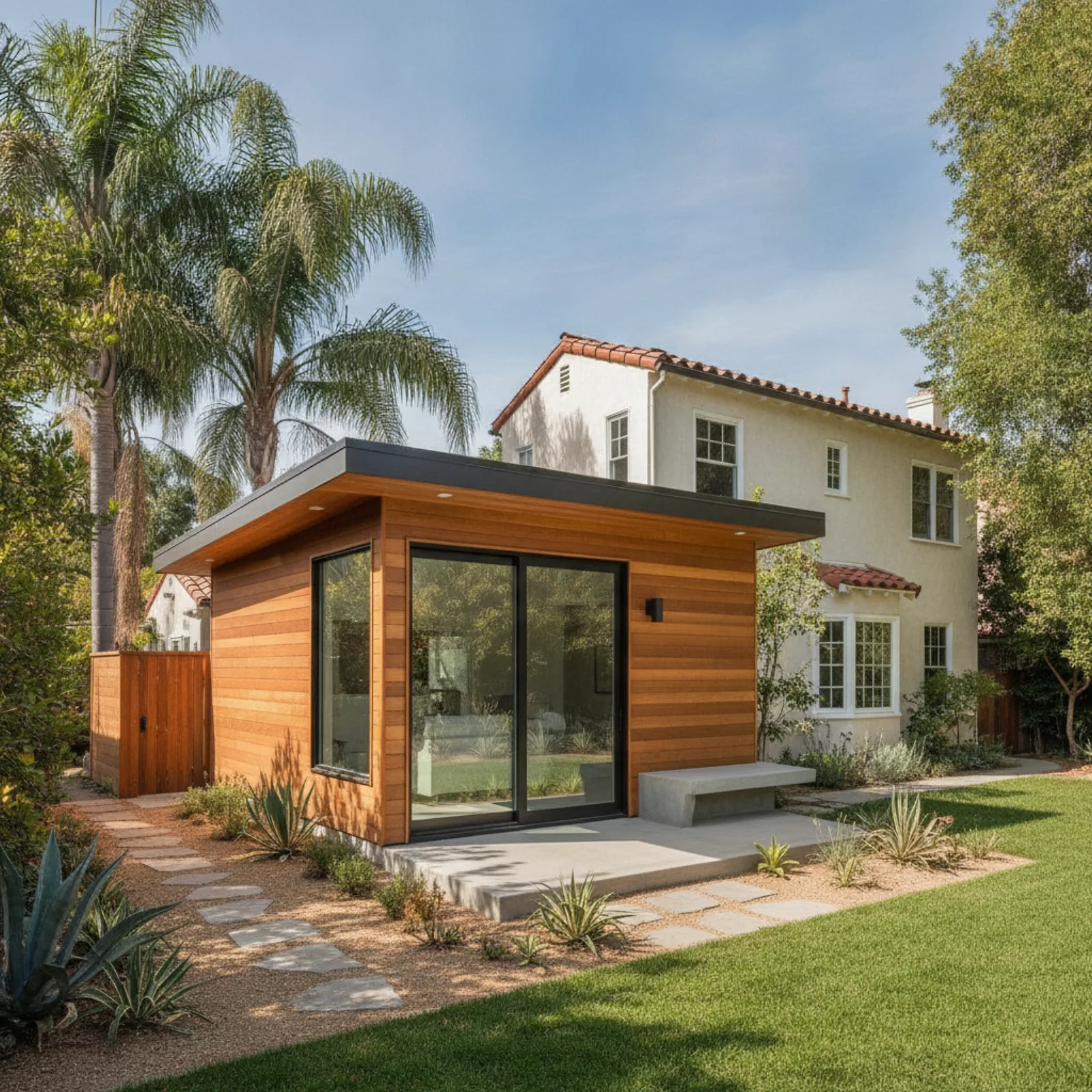
Before you can plan an ADU, you need to know which type actually fits your property. The two most commonly compared options are the detached ADU and the junior ADU (JADU), and they are fundamentally different in what they cost, where they go, who they work for, and how much income they can generate.
The right choice depends on your lot, your budget, and your goal. This guide breaks down each option so you can walk into the planning conversation knowing what you are looking at.
What Is a Detached ADU?
A detached ADU is a completely separate living unit that stands on its own on your property, independent of the main house. It has its own entrance, its own kitchen, its own bathroom, and its own address. It can be built in a backyard, beside the house, or even above a garage, as long as it does not share walls with the primary residence.
California allows detached ADUs up to 1,200 square feet, though local jurisdictions can set lower maximums based on lot size or other factors. In most San Diego County cities, you can build something in the 400 to 1,200 square foot range. The unit functions entirely independently from the main home.
What Is a Junior ADU (JADU)?
A junior ADU, often called a JADU, is a smaller unit created within the existing footprint of the primary residence. That typically means converting part of a home: a bedroom suite, an attached garage, or an interior space that already has some of the right bones.
California law caps junior ADUs at 500 square feet. They must have their own exterior entrance, a kitchen or efficiency kitchen, and a bathroom. Unlike a detached ADU, a JADU can share a bathroom with the main house under certain conditions, which sometimes allows conversions that would otherwise be difficult.
One important rule: the owner must live on the property when a JADU is present, either in the main house or in another unit on the lot. That owner-occupancy requirement does not apply to detached ADUs in most cases.
Detached ADU: up to 1,200 sq ft, fully independent, higher cost, higher rental income potential. Junior ADU: up to 500 sq ft, carved from existing space, lower cost, owner-occupancy required.
Cost Comparison
This is where the decision often gets made.
Junior ADUs are the more affordable option because you are mostly working within existing square footage. You are adding an exterior entrance, a small kitchen or kitchenette, and potentially a bathroom. Depending on the condition of the existing space and the complexity of the plumbing, a JADU in San Diego County typically runs $40,000 to $100,000.
Detached ADUs cost more because you are building a full structure. Foundation, framing, roofing, exterior finishes, all new systems. Budget $150,000 to $300,000 or more depending on size, finishes, and site conditions. Slope, soil conditions, and utility connection distance all affect the final number.
The tradeoff is real: a JADU costs less but produces a smaller unit with more restrictions. A detached ADU costs more but gives you something that functions independently at a much higher rental price point.
Privacy and Livability
If you are adding space for a family member, the privacy question matters a lot.
A junior ADU is attached to the main house. Sounds carry. You share a wall, a yard, and often a driveway. For a close-knit family situation where togetherness is part of the point, that works well. For an adult child who wants independence, or an aging parent who needs their own space without feeling like a guest, it can feel cramped.
A detached ADU offers genuine separation. The unit is its own place. There is physical distance, a separate entrance, and usually a sense of real privacy for both households. Most families who have done both say the detached unit feels more sustainable long-term.
Rental Income Potential
This is where the detached ADU pulls ahead clearly.
A JADU at 400 to 500 square feet in San Diego County might rent for $1,200 to $1,800 per month depending on location and condition. It is a smaller unit with less privacy, which affects what the market will bear.
A detached ADU at 800 to 1,200 square feet can rent for $1,800 to $3,000 or more per month in most San Diego County communities. It also qualifies as a fully independent rental in a way that a JADU does not always, which gives you more flexibility with lease terms and tenant situations.
If return on investment is the primary goal, the detached ADU almost always generates more income over time, even accounting for the higher upfront cost.
Which One Fits Your Lot?
A junior ADU makes sense when:
- Your lot is small and there is no room for a separate structure
- Budget is the main constraint and you need the lowest possible entry cost
- You have an existing interior space that is already partitioned and easy to convert
- The goal is housing a family member nearby with shared yard access and close connection
A detached ADU makes sense when:
- You have backyard space or a garage footprint that can support a separate structure
- Privacy matters for both households
- You want to maximize rental income and long-term property value
- You plan to rent to someone outside the family and want full independence between units
- You want a unit that could function as its own home if you ever sell or need to move
The Planning Conversation Matters
Neither option is universally better. The right answer depends on what your lot actually allows, what your goals are, and what your budget can support. Getting that picture early, before you start building expectations around a particular path, saves real time and money.
ADUz handles ADU design and permitting across San Diego County. We are a family-owned team, bilingual, and we work with homeowners at every stage of the process. When your project is ready to build, our licensed partner The Rock Remodel (CA 1042918) takes it from permitted plans to a finished unit.
Call us at (760) 524-1754 for a free ADU consultation. We will look at your property and help you figure out which option actually works for your situation, so you are not guessing. ADUz: designed for the way your family grows.