
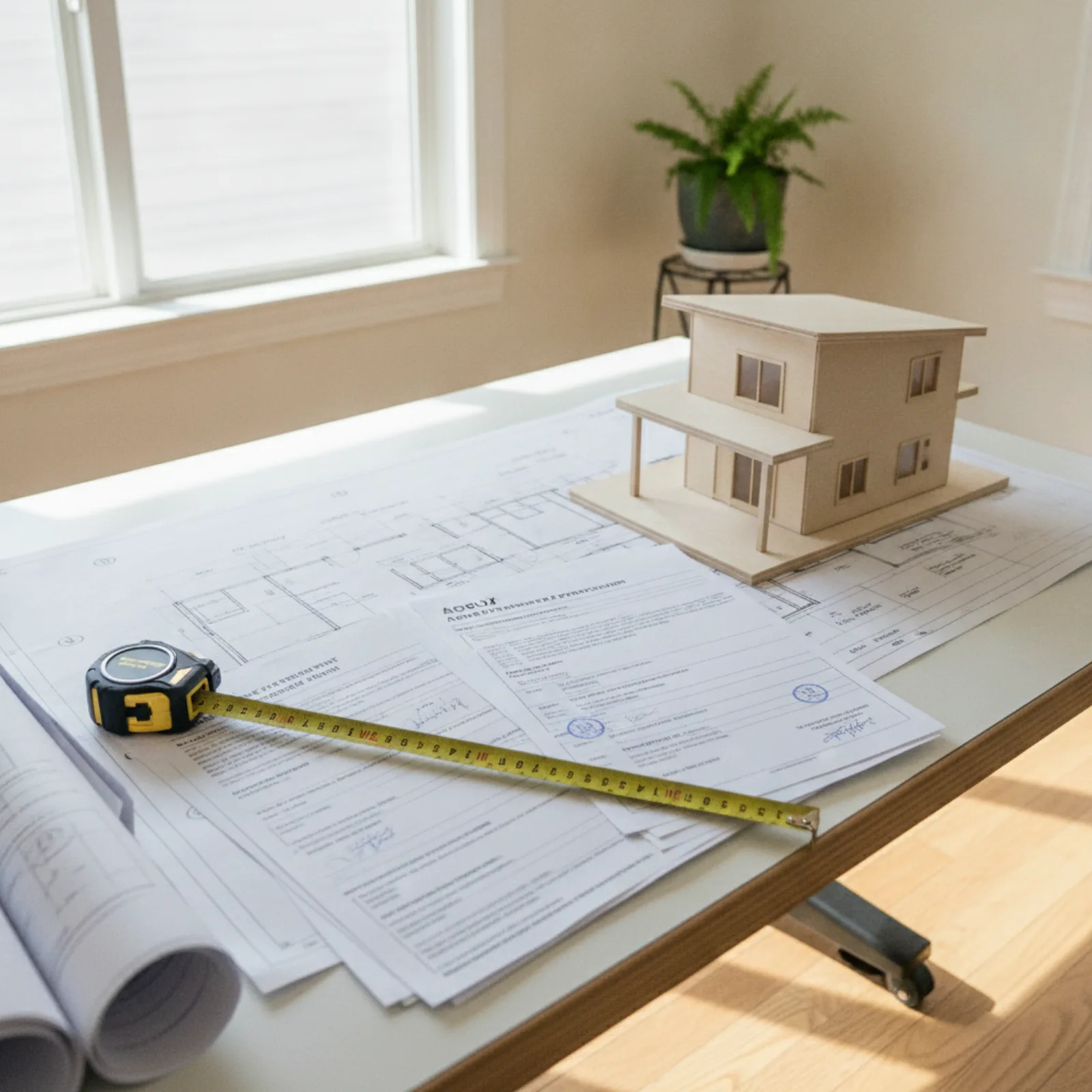
The ADU permit process in San Diego is one of the most common things people want to understand before committing to a project. The good news is that California has made ADU permitting significantly more streamlined over the last few years. The honest news is that it still takes time, requires precise drawings, and involves a real back-and-forth with your local jurisdiction.
This post walks through every step so you know what to expect.
Step 1: Feasibility Before You Spend a Dollar on Plans
Before any drawings get made, you need to know whether your lot can actually accommodate the ADU you have in mind.
Feasibility covers things like: lot size and zoning, setback requirements (how far the unit needs to be from property lines), height limits, whether there are HOA restrictions, what utility infrastructure exists, and whether there are any deed restrictions or easements that affect where you can build.
This step saves people from spending thousands on architectural drawings for a project that can’t get approved. ADUz does a feasibility review before we start on plans, so you’re not designing something the jurisdiction won’t approve.
Step 2: Design and Construction Documents
Once feasibility confirms your project is viable, the design phase begins. This is where your ADU takes shape: floor plan, elevations, site plan showing where the unit sits on the lot, and all the technical details the city or county needs to review.
In San Diego, ADU drawings need to address:
- Architectural plans (floor plan, elevations, sections)
- Site plan (scaled, showing property lines, setbacks, existing structures)
- Structural calculations for new construction
- Title 24 energy compliance
- Grading and drainage plans if site work is needed
The detail required at this stage is real. Incomplete drawings are the number one reason plan checks take longer than they need to.
Step 3: Submittal to the Jurisdiction
San Diego County is not one permit office. Depending on where your property is, you’ll be working with the City of San Diego, the County of San Diego unincorporated area, or one of 17 other cities (Chula Vista, El Cajon, Escondido, Santee, Vista, etc.). Each has its own portal, its own fee schedule, and its own review timeline.
Most jurisdictions now accept electronic submittals, which speeds things up. You submit the full drawing package, pay the initial permit and plan check fees, and the clock starts on the review.
State law requires jurisdictions to approve or deny ADU applications within 60 days of a complete submittal. In practice, the first submittal is rarely complete, which is why corrections are a normal part of the process, not a sign that something went wrong.
Step 4: Plan Check and Corrections
The plan checker reviews your drawings against the California Building Code, local zoning ordinances, and any jurisdiction-specific requirements. This process usually takes 4 to 8 weeks on a first submittal, though some jurisdictions run faster or slower depending on their backlog.
The plan checker will typically come back with a corrections list: things that need to be clarified, revised, or added to the drawings. Common corrections include:
- Unclear dimension on a setback
- Missing structural detail at a beam connection
- Energy compliance calculation that needs updating
- Grading note that doesn’t match the site plan
This is normal. A first submittal that comes back with zero corrections is the exception, not the rule. The key is having a designer who reads the corrections carefully, responds accurately, and doesn’t create new problems while fixing the old ones.
Step 5: Resubmittal and Approval
Once corrections are addressed, you resubmit. If the plan checker is satisfied, you get your permit issued. If there are additional corrections (which sometimes happens, especially on complex projects), you go through another round.
Most projects in San Diego require one to two rounds of corrections before the permit is issued. Projects in coastal zones or on hillside lots sometimes require more.
When the permit is issued, you receive stamped approved drawings. Those are the documents your contractor builds from, and they have to match what you build.
Step 6: Construction and Inspections
With permit in hand, construction can begin. Throughout the build, the city or county inspector visits at specific milestones to verify the work matches the approved plans:
- Foundation inspection (before concrete is poured)
- Framing inspection (before insulation or drywall)
- Rough electrical, plumbing, and mechanical inspections
- Insulation inspection
- Final inspection (when everything is complete)
Failing an inspection usually means a specific correction that needs to be made before the inspector returns. Having your contractor and designer on the same page throughout construction makes inspections go smoothly.
Step 7: Final Approval and Certificate of Occupancy
When all inspections pass, the jurisdiction issues a Certificate of Occupancy (or equivalent final sign-off). That document makes the ADU legal to rent or occupy.
This is also when the ADU gets added to the property’s assessed value, which may affect your property taxes going forward.
How Long Does the ADU Permit Process Take in San Diego?
From feasibility to Certificate of Occupancy, most ADU projects in San Diego County take 12 to 18 months. Here’s a rough breakdown:
- Feasibility and design: 4 to 8 weeks
- Permit submittal and plan check (including corrections): 3 to 6 months
- Construction: 4 to 8 months
- Inspections through final: built into the construction timeline
Projects in cities with faster plan check turnaround, or simpler scope (like a JADU that doesn’t require grading), can come in closer to 9 to 12 months total.
What ADUz Handles
The permit process involves a lot of back-and-forth with jurisdictions, and it’s easy for things to get stuck if nobody is actively managing the file. ADUz handles the entire design and permitting side: drawings, submittal, corrections, resubmittals, and coordination with the city or county through final approval.
When construction begins, David Sanchez and The Rock Remodel (CA Lic. 1042918) take over as the licensed build partner. Because Alma and David work together, the transition from permitted drawings to active construction is clean. The contractor already knows the project inside and out.
We’re a family-owned company, bilingual, and based here in San Diego County. We’ve walked families through this process for garage conversions, backyard cottages, and junior ADUs. We know where projects get stuck, and we know how to keep them moving.
Start With a Free Consultation
If you’re trying to figure out whether an ADU is right for your property and how long the process realistically takes, the best first step is a conversation.
Call ADUz at (760) 524-1754 to schedule your free ADU consultation. We’ll look at your lot, answer your questions, and give you a real picture of the timeline and process for your specific situation.