
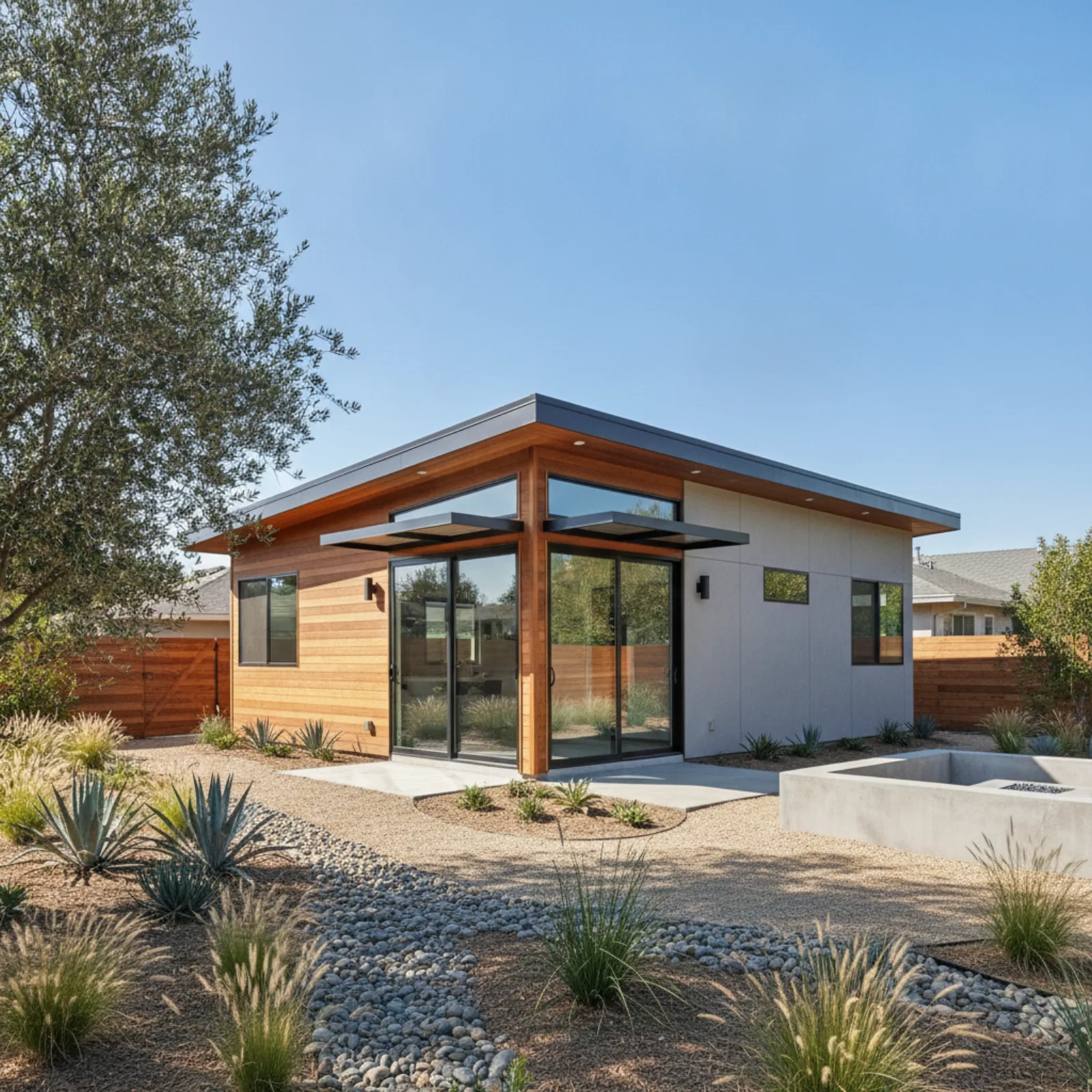
California ADU laws in 2026 are more homeowner-friendly than they have ever been. The state has spent the last several years systematically removing the roadblocks that cities used to put in front of ADU projects, and the result is that most San Diego County homeowners can build an ADU with fewer restrictions than they might expect.
This post explains the core rules in plain English. Keep in mind that ADU law changes regularly and some local details vary by city and county, so always confirm specifics with a permit professional before finalizing plans.
What California Law Requires Cities to Allow
State law sets a floor. Cities can add requirements on top of it, but they cannot fall below what the state mandates. Here is what every city in California must allow:
- At least one ADU per single-family lot, and in most cases more than one
- An ADU of up to 800 square feet with 4-foot side and rear setbacks, regardless of what local zoning would otherwise allow
- A Junior ADU (JADU) inside the existing home, up to 500 square feet, on any single-family lot
- Attached ADUs up to 50 percent of the existing living area, and detached ADUs up to 1,200 square feet in most cases
Those numbers matter because they are minimums, not maximums. Your city may allow larger units depending on lot size and zoning.
What Cities Cannot Require
This is where a lot of homeowners are pleasantly surprised. State law is specific about what local governments are not allowed to demand:
Setbacks for converted structures. If you are converting an existing garage, accessory building, or other structure into an ADU, the city cannot require it to meet new setback requirements as long as it is at least 4 feet from the side and rear property lines. This opens up a huge number of garage conversions that would have been blocked by old setback rules.
Replacement parking. If you eliminate a garage parking space to create your ADU, the city cannot make you replace that parking space somewhere else on the property. This removed one of the biggest cost barriers for garage conversions in San Diego.
Owner-occupancy requirements (through at least 2025). A temporary state provision suspended owner-occupancy requirements for many ADU projects, meaning you do not need to live on the property to build or rent an ADU. Confirm whether this provision is still in effect and applies to your situation, as it has been subject to changes.
Design requirements that add significant cost without benefit. The city cannot impose design standards that functionally make the ADU unaffordable or infeasible to build.
How Ministerial Approval Works
One of the most important changes California made is the shift to ministerial approval for ADU permits. Ministerial means the city reviews your plans against a checklist of objective standards. If your plans meet the standards, the permit must be approved. There is no discretionary review, no design review board, no planning commission hearing that neighbors can show up to oppose.
This matters for two reasons. First, it speeds things up considerably. Cities are required to act on a complete ADU permit application within 60 days. Second, it removes a lot of the uncertainty that used to make ADU projects feel risky.
Ministerial approval means your ADU permit is a checklist, not a committee. If your plans meet the standards, it gets approved. No public hearings. No neighbor veto.
The Size Rules Worth Understanding
State law sets a 4-foot side and rear setback as the minimum allowed for new detached ADUs. Front setback requirements still apply based on your city’s standards. Maximum height for detached ADUs is generally 16 feet, though your city may allow more in certain zones.
For attached ADUs, you can generally go up to 50 percent of the existing home’s square footage or 800 square feet, whichever is larger.
The 800 square foot rule is significant: even if 50 percent of your home’s square footage is less than 800 square feet, you can still build up to 800 square feet as a minimum right.
Fees and Utility Connections
Cities are required to waive or reduce certain fees for small ADUs and JADUs. Impact fees, for example, cannot be charged for ADUs under 750 square feet. Connection fees for utilities must be proportionate to the actual impact of the new unit, not based on the same rates as a new primary home.
This has meaningfully reduced the cost of smaller ADU projects. A JADU or small studio conversion can now come in significantly under budget compared to what the same project would have cost several years ago.
What Has Not Changed
Local cities still control their own zoning standards for things like lot coverage, floor area ratio, and overall design guidelines. They still require plans to meet building code. And they still have some discretion over certain design details, as long as those details do not functionally prevent an otherwise allowed ADU.
Permit processing still takes time. Requirements vary by city. San Diego, Oceanside, Escondido, Chula Vista, El Cajon, and unincorporated San Diego County each have their own local ADU ordinances layered on top of the state baseline.
A Note on Staying Current
ADU law in California has changed significantly almost every year since 2017, and 2026 is no exception. New bills move through Sacramento regularly. Local cities update their ordinances. The information in this post reflects general principles as of early 2026, but you should always work with someone who stays current on permit requirements before making decisions about your project.
Talk to Someone Who Knows This Well
ADUz works through the design and permitting process for ADUs across San Diego County every day. We know how state law applies in different cities, what local ordinances allow, and how to structure your project to move through the permit process as smoothly as possible.
We are a family owned company, bilingual, and built to help San Diego families figure out what is actually possible on their property. Our licensed build partner The Rock Remodel (CA License #1042918) handles construction once permits are in hand.
Call us at (760) 524-1754 for a free consultation. We will walk through your lot, your goals, and what the current rules mean for your specific situation.